Throttle Buff is reader-supported: we may earn a commission when you buy through links on this page. Read our affiliate disclosure.
The best motorcycle balaclava for most riders is the Klim Balaclava: a thin COOLMAX head section that fits under any helmet, plus a GORE WINDSTOPPER neck that blocks the cold air coming up your collar, for about $40. For real winter riding, step up to the fully windproof REV’IT! Maximus 2 GTX WINDSTOPPER, and if you ride a modular helmet or wear glasses, the hinged Klim Shadow is the easiest to live with.
Quick picks
-
Best overall
- Best for
- Best overall
- Key material
- COOLMAX head, WINDSTOPPER neck
- Price
- $$
-
Best for cold and wind
REV'IT! Maximus 2 GTX WINDSTOPPER Balaclava
- Best for
- Cold and wind
- Key material
- GORE-TEX WINDSTOPPER softshell
- Price
- $$$
-
Best for modular helmets and glasses
- Best for
- Modular helmets and glasses
- Key material
- 300g fleece, hinged hood
- Price
- $$
-
Best for summer
- Best for
- Summer
- Key material
- Thin Coolskin wicking fabric
- Price
- $
- Best heated: Mobile Warming Heated Balaclava
- Best for touring collar seal: Alpinestars Winter Touring Balaclava
- Best three-season: REV'IT! Micro 2 Balaclava
- Best budget: ZANheadgear Polyester Balaclava
We chose these picks from research, not hands-on testing. We compared manufacturer specs and materials, RevZilla and brand-site listings, sizing charts and owner reviews, then picked one clear winner for each type of rider: summer, cold weather, heated, budget, and modular-helmet or glasses wearers.
Best motorcycle balaclava comparison
| Balaclava | Best for | Key material | Price |
|---|---|---|---|
| Klim Balaclava | Best overall | COOLMAX head, WINDSTOPPER neck | $$ |
| REV’IT! Maximus 2 GTX WINDSTOPPER | Cold and wind | GORE-TEX WINDSTOPPER softshell | $$$ |
| Klim Shadow | Modular helmets and glasses | 300g fleece, hinged hood | $$ |
| Schampa Coolskin | Summer | Thin Coolskin wicking fabric | $ |
| Mobile Warming Heated Balaclava | Heated | Stretch fleece, 7.4V battery | $$$$ |
| Alpinestars Winter Touring | Touring collar seal | Lycra panels, waterproof neck skirt | $$$ |
| REV’IT! Micro 2 | Three-season | Seamless polyamide/elastane knit | $$$ |
| ZANheadgear Polyester | Budget | 100% stretch polyester | $ |
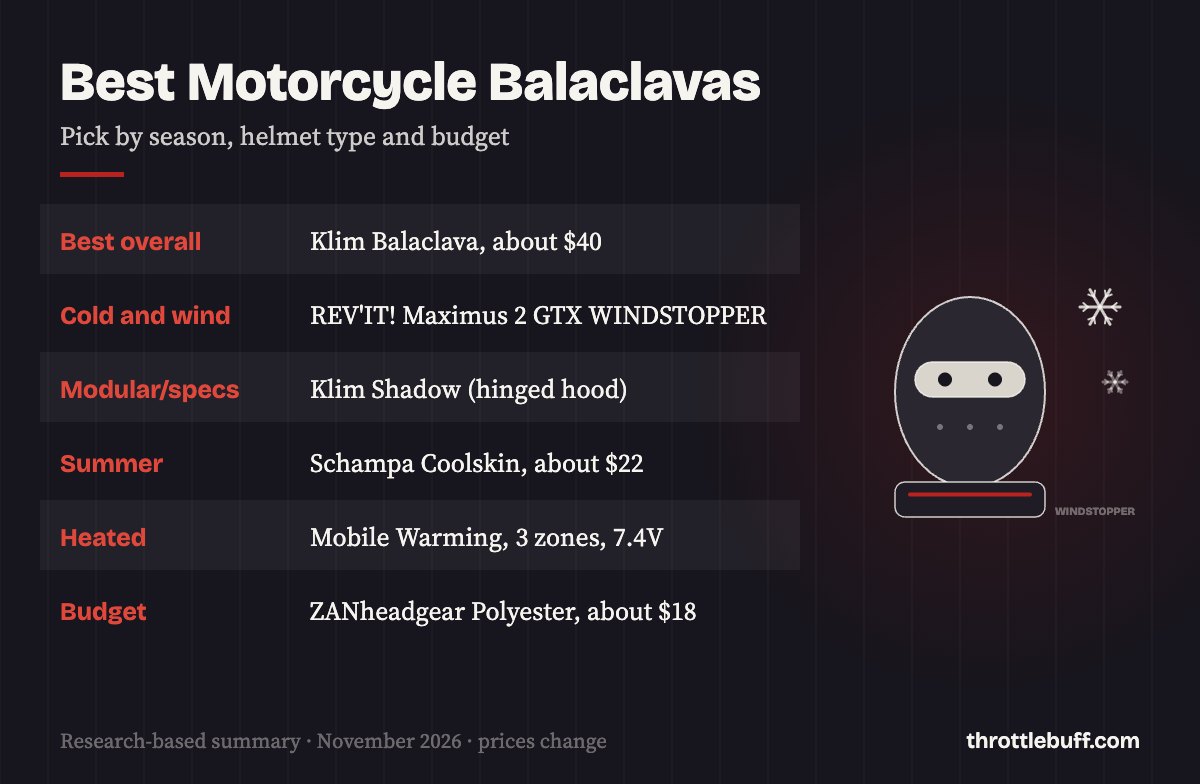
Specs come from manufacturer pages and RevZilla listings checked in November 2026. Prices change often, and some colors or sizes sell out in winter.
The best motorcycle balaclavas in detail
1. Klim Balaclava: best overall

The Klim Balaclava splits the job in two. The head uses COOLMAX, a breathable fabric that wicks sweat, so it stays thin under the helmet liner. The neck uses GORE WINDSTOPPER, which stops wind from funneling up between your jacket collar and chin bar, where most riders feel the cold first.
A stretch panel at the back adjusts to different head shapes, and flat-lock seams keep ridges off your scalp. It comes in one size, and Klim lists it at $39.99.
Pros
- Thin crown fabric that does not crowd a snug helmet
- Windproof neck where cold air gets in
- Flat-lock stitching and a stretch back panel
Cons
- One size only, so very large or small heads may not get a close fit
- Not warm enough on its own for freezing rides
2. REV’IT! Maximus 2 GTX WINDSTOPPER: best for cold and wind

If you ride below 40°F, wind is the enemy, and the Maximus 2 is built around stopping it. The shell is a 3-layer GORE-TEX WINDSTOPPER softshell with a warm-weight laminate and soft fleece inside, plus a windproof front panel. It covers your whole head and neck except the eyes.
REV’IT! added a breathing panel at the mouth and nose to cut moisture build-up, a seamless eye opening and reflective panels on the front. It comes in S, M and L, sized to helmet size (about 53 to 64 cm head circumference across the range). RevZilla lists it at about $48.
Pros
- Windproof and water-repellent fabric
- Breathing panel to reduce visor fog
- Three sizes matched to helmet sizing
Cons
- Thicker than a liner, so it can crowd a tight helmet
- Too warm for summer
3. Klim Shadow: best for modular helmets and glasses

The Shadow’s hinged hood is the reason it is here. The face section pulls down under your chin, sits over or under your nose, and the head section folds back. That means you can flip up a modular chin bar at a gas stop and talk, drink or wipe your glasses without pulling the whole thing off.
It uses a 300g midweight fleece with a lighter, breathable head section and 4-way stretch. Klim lists it at $29.99. Fleece is warmer than most thin liners, so it suits fall and winter more than July.
Pros
- Hinged face section adjusts without removing your helmet
- Warm fleece at a low price
- Lighter head panel to save helmet space
Cons
- Fleece is not windproof
- Hi-Vis color often backordered
4. Schampa Coolskin: best for summer

A summer balaclava is about sweat and hygiene, not warmth. The Coolskin is a thin, close-fitting liner that sits between your head and the helmet’s comfort liner, so the balaclava soaks up sweat and grime instead of the pads. The fabric is breathable and wicking.
Because it is so thin, it adds almost nothing to helmet fit. It is one of the cheapest options here at about $22. RevZilla stock has been patchy, so check sizes before you plan around it.
Pros
- Very thin, so it does not change helmet fit
- Keeps helmet pads cleaner
- Low price
Cons
- No wind protection
- Stock comes and goes
5. Mobile Warming Heated Balaclava: best heated
For riders who already run heated gloves or a jacket liner, a heated balaclava fills the last cold gap. The Mobile Warming (Fieldsheer) Heated Balaclava heats three zones: both ears and the back of the neck. You pick from four heat levels with a waterproof button or through the MW Connect app over Bluetooth.
It runs on a 7.4V lithium-ion battery, rated at 2+ hours on high and up to 10 on low, and takes 3 to 4 hours to recharge. The shell is water-resistant bonded stretch fleece with a wicking mesh liner, and it is machine washable. List price is $119.99, though it is often discounted. RevZilla does not currently carry it.
Pros
- Active heat at the ears and neck
- Four settings plus app control
- Battery-powered, so no wiring to the bike
Cons
- Bulkier than an unheated liner; check helmet fit
- Battery needs recharging after every few rides
- Not sold at RevZilla
6. Alpinestars Winter Touring Balaclava: best for touring collar seal

The standout feature here is an external waterproof, windproof neck skirt that lies over the top of your jacket collar. On long highway days, that seal keeps wind and rain from running down your chest.
Under the helmet it uses stretch fabric with double-sided Lycra panels, a microfiber inner lining for warmth, flat-lock seams and an open nose panel for breathing. It is one size and lists at $54.95. Alpinestars shows a 4.6 rating from 12 reviews, but stock has been thin at times.
Pros
- Waterproof neck skirt overlaps the jacket collar
- Open nose panel for easier breathing
- Covers neck and upper shoulders
Cons
- One size only
- Frequently out of stock
7. REV’IT! Micro 2: best three-season balaclava

The Micro 2 is a seamless 3D round-knit balaclava made of polyamide, polyester and elastane. Knitting it in the round removes most seams, which means fewer pressure points under a tight sport helmet.
REV’IT! knits mesh zones at the nose and mouth for airflow, uses an open structure over the ears so you can still hear, and adds an antibacterial, odor-control finish. It comes in S, M and L matched to helmet size and sells for about $53. It is designed for spring, summer and fall, not deep winter.
Pros
- Nearly seamless, with a seamless eye opening
- Mesh breathing zones and open-knit ear zones
- Antibacterial, odor-control finish
Cons
- Pricey for a thin liner
- Not windproof
8. ZANheadgear Polyester Balaclava: best budget

If you want a basic layer for under $20, the ZANheadgear Polyester Balaclava does the job. It is 100% stretch polyester with two smooth seams placed to avoid pressure points and a contoured cut to limit bunching under the helmet.
It will not block wind, but it makes helmets easier to slide on, keeps pads cleaner and comes in many prints. It is a good spare for a tank bag.
Pros
- About $18
- Thin, with seams placed away from pressure points
- Lots of colors and graphics
Cons
- Basic fabric with no wind protection
- Not as breathable as premium wicking fabrics
How to choose a motorcycle balaclava
Material
Match the fabric to the temperature. Thin wicking synthetics (COOLMAX, polyamide knits, lightweight polyester) are for summer and three-season riding. Fleece adds warmth but lets wind through. Windproof membranes such as GORE WINDSTOPPER stop wind chill, which matters more at speed than fabric thickness. Silk and merino are other comfortable options for liners.
Many riders own two: a thin liner and a windproof one. For a full cold-weather system, see our guide on how to stay warm riding a motorcycle.
Thickness and helmet fit
A helmet should fit snugly with nothing under it. A thick balaclava takes up space, so it can make the helmet press on your forehead or cheeks, or keep it from seating fully. That is uncomfortable and can affect how the helmet performs in a crash. Thin liners rarely cause problems. With fleece or windproof designs, try your helmet on with the balaclava before you ride, and look for models that keep the crown thin and put the bulk at the neck, like the Klim Balaclava and Klim Shadow.
If your helmet already feels tight with a thin liner, check the fit against our helmet sizing guide instead of forcing a thicker layer in.
Breathing and visor fogging
A balaclava covering your mouth can push warm, moist breath up toward the visor. Look for a mesh or perforated breathing panel (the REV’IT! Maximus 2 and Micro 2 both have one) or an open nose design like the Alpinestars. Keep the fabric tucked below your nose and use a breath guard and Pinlock insert if your helmet has them. Our guide on how to stop helmet visor fogging covers the rest.
Hinged vs. full balaclavas
A full balaclava is one closed piece with an eye opening. It seals best but has to come off with the helmet. A hinged design, like the Klim Shadow, lets the face section drop under your chin. That is handy with a modular helmet, when you wear glasses, or when you want to eat or talk at a stop without undressing your head.
Glasses
Thin fabric at the temples matters more than anything else if you wear glasses. Thick fleece over your ears pushes the arms of your glasses into your head. Put the balaclava on first, then the glasses, then the helmet. A helmet with eyewear channels also helps; see our picks for the best motorcycle helmet for glasses.
Hygiene and care
A balaclava is far easier to wash than helmet pads. Wash it every few rides in summer. Follow the label: REV’IT! calls for a 30°C (86°F) wash and line drying for the Maximus 2, and a mild machine cycle without tumble drying for the Micro 2. Take the battery out of a heated balaclava before washing it. Antibacterial and odor-control finishes help between washes but do not replace them.
Heated or unheated
Heated balaclavas cost more and add bulk, but they make sense if you commute through winter or already wear heated gear. Most use small rechargeable batteries rather than the bike’s 12V system. If your hands are the bigger problem, start with our best heated motorcycle gloves.
FAQ
Should I wear a balaclava under my motorcycle helmet?
It is optional, but useful. A balaclava keeps sweat and oil off the helmet liner, makes the helmet easier to put on, and adds warmth and wind protection in cold weather. Just make sure the helmet still fits correctly with it on.
Will a balaclava make my helmet too tight?
A thin summer liner usually will not. Fleece and windproof balaclavas can, especially at the forehead and cheeks. Try them together before a ride. If the helmet presses hard or will not seat fully, switch to a thinner model.
What is the best balaclava for cold weather riding?
A windproof balaclava is the biggest upgrade, because wind chill does most of the damage at speed. The REV’IT! Maximus 2 GTX WINDSTOPPER is our pick. Below freezing, a heated balaclava like the Mobile Warming model adds active heat at the ears and neck.
Is a balaclava good for summer riding?
Yes, if it is thin and wicking. A summer liner absorbs sweat before it reaches the helmet pads and can feel cooler as moisture evaporates. The Schampa Coolskin and REV’IT! Micro 2 are made for this.
For most riders, the Klim Balaclava is the one to buy first: thin where your helmet needs room and windproof where cold air gets in. Add the REV’IT! Maximus 2 for real winter riding, or the Klim Shadow if you run a modular helmet or glasses.