Throttle Buff is reader-supported: we may earn a commission when you buy through links on this page. Read our affiliate disclosure.
Can you paint a motorcycle helmet? Yes, but only within the helmet maker’s rules. Shoei Europe allows water-based or acrylic paint, Arai allows air-drying paint with the inside fully masked, and Snell says never to use a paint the manufacturer has not authorized. Solvent-based paint, thinners and heat curing can damage the shell or the foam liner in ways you cannot see.
Most painting guides jump straight to sandpaper and spray cans. This one starts where the risk is: what the makers, Snell and the US DOT standard put in writing about paint, stickers and wraps, and how to stay inside those rules if you go ahead.
What helmet makers say about paint and stickers
| Source | Paint | Stickers and wraps |
|---|---|---|
| Shoei (global FAQ) | Painting it yourself is not recommended. If you do, mask everything except the shell and never use paint that needs drying above 50°C (122°F) | Not covered |
| Shoei Europe | Water-based or acrylic paint only. Painting voids the warranty | Solvent-free adhesive only. Do not heat the shell or liner. Never cover a damaged helmet |
| Arai (owner’s booklet) | Air-drying paint only, never heat-cured. Mask every opening with paper and tape | No stickers or tape on the shield |
| Snell Foundation | Never repaint with paint the manufacturer has not authorized | Not covered |
| US DOT standard (FMVSS No. 218) | The helmet’s own label must list the paints and adhesives the maker approves | The DOT label on the back must stay permanent and legible |
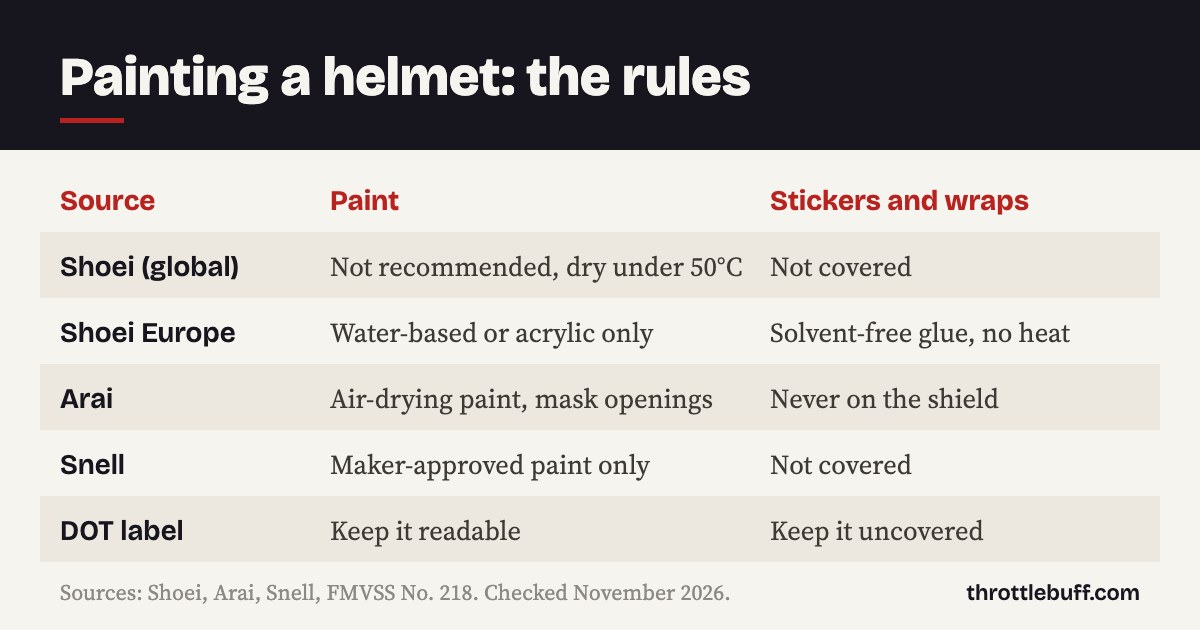
The sources are Shoei’s painting FAQ, the Shoei Europe FAQ, Arai’s general instruction booklet, the Snell Foundation FAQ and the text of FMVSS No. 218, all read in November 2026. Other brands set their own rules, so treat this table as a pattern, not a blanket permission.
Why paint can damage a motorcycle helmet
A helmet protects you with two parts: a hard outer shell and a liner of expanded polystyrene (EPS) foam that crushes to absorb the hit. Our explainer on why helmets break on impact covers how that works. The trouble is that both parts react to chemicals.
Arai’s booklet warns that paint can adversely affect the EPS liner and the plastic components, which is why it tells owners to mask all openings. It also says never to use petrol, thinner, benzene or other solvents on the helmet. Shoei gives the same reason for not recommending home paint jobs: some helmet materials may be damaged by paints or thinner.
The DOT standard treats this as serious enough to require a warning on every helmet. Under FMVSS No. 218, the label inside must tell the buyer that the helmet “can be seriously damaged by some common substances without damage being visible to the user” and then list what is safe to apply, including paints and adhesives. That hidden damage is the real risk. A helmet can look perfect and still have a weakened shell or liner.
Heat is the second problem. Shoei sets a ceiling of 50°C (122°F) for drying, and Arai rules out any paint that needs heat curing. A paint booth oven, a heat lamp or a heat gun can all go past that.
Can you paint a motorcycle helmet and keep it DOT legal?
Nothing in FMVSS No. 218 bans a painted helmet. The standard applies to the helmet as the maker certifies it, and it tells owners to “make no modifications”. What it does require is a certification label that stays permanent and legible on the outer surface at the back, with the DOT symbol between 1 and 3 inches from the bottom edge.
That label is what a police officer or inspector looks for, so never paint or wrap over it. Mask it before any paint goes on. Our guide on how to tell if a helmet is DOT approved shows what a genuine label looks like, and you can check the helmet rules where you ride in our helmet laws by state lookup.
Snell is stricter. Its FAQ says never to repaint with paints the manufacturer has not authorized, and it advises owners not to modify a certified helmet. If Snell certification matters to you for track days or racing, ask the organizer before you paint. The differences between the standards are in our helmet safety ratings guide.
How to paint a helmet within the maker’s rules
These steps come from the manufacturer instructions above. They do not replace your own helmet’s manual.
1. Read the label and the manual first
Look inside the helmet for the list of approved cleaning agents, paints and adhesives, then check the manual or the brand’s FAQ. If the maker says no, the answer is no. Expect the warranty to end either way: Shoei Europe says painting voids it.
2. Start with a sound helmet
Do not paint a helmet that has taken an impact or is near the end of its life. Fresh paint hides cracks. Arai recommends retiring a helmet five years after first use, and our helmet expiration guide shows how to find the build date.
3. Take off only the removable parts
Remove the shield and any parts designed to come off. Arai says never to remove permanent parts such as the EPS liner, chin straps, rivets, bolts or fixed interior linings to paint a helmet.
4. Mask everything that is not shell
Cover the whole interior, every vent, the shield opening, rubber trim and the DOT label with paper and tape. The goal is that no paint mist reaches the foam liner.
5. Use water-based or acrylic, air-drying paint
That is the overlap between Shoei Europe and Arai. Skip thinners, solvent cleaners and any product that needs baking. Clean the shell beforehand with mild soap and water, the same method as in our helmet cleaning tips.
6. Let it dry at room temperature
No oven, no heat lamp, no hair dryer on high. Stay well under Shoei’s 50°C limit and give the paint the full drying time on the can before you ride.
One thing the makers’ instructions do not cover is sanding the shell, so we will not guess. Arai does say never to drill the shell or cut the liner. If your design needs heavy prep, a helmet painter who works with your brand’s rules is the safer route.
Stickers and wraps: the lower-risk option
Stickers and vinyl wraps change the look without wet paint, but they are not rule-free. Shoei Europe allows only stickers or films with solvent-free adhesive and says the shell and EPS liner must not be heated before applying them. That matters for wraps, because vinyl is usually stretched with a heat gun. Shoei Europe also says a damaged helmet must never be covered, and Arai says to keep stickers and tape off the shield because they weaken its hard coating.
If you mostly want a helmet that looks different, the simplest answer is to buy the graphic you like. Our best motorcycle helmets guide lists current models, and most come in several factory finishes that keep the warranty intact.

FAQ
Can you paint a motorcycle helmet with acrylic paint?
Acrylic is one of the two types Shoei Europe allows, along with water-based paint. Check your own brand’s rule first, mask the interior and let it air dry.
Can I spray paint a motorcycle helmet?
Only if the paint in the can meets the maker’s rule. Many aerosol paints carry solvents, which is what Shoei and Arai warn about. A water-based or acrylic product, sprayed with every opening masked, is the version the makers describe.
Is it better to paint or wrap a motorcycle helmet?
A wrap or stickers avoid wet solvents and can be removed, so they are the lower-risk choice. Use solvent-free adhesive and do not heat the shell. Paint is permanent and ends the warranty with some brands.
Does painting a helmet void the warranty?
With Shoei in Europe, yes. Shoei also says it cannot make any statement about how the helmet protects after a repaint. Other brands differ, so ask before you start.
Can you put stickers on a motorcycle helmet?
On the shell, yes with most brands, as long as the adhesive is solvent-free and the helmet is undamaged. Keep them off the shield and never cover the DOT label.
Verdict
You can paint a motorcycle helmet, but the safe version is narrow: a sound helmet, water-based or acrylic air-drying paint, the inside fully masked, no heat, and the DOT label left alone. Anything outside the maker’s written rules risks damage you cannot see, and it usually costs you the warranty. If the brand says no, use solvent-free stickers or pick a factory graphic instead. And if you are choosing between premium brands with painting in mind, our Shoei vs Arai comparison is a good place to start.
Browse all our helmet guides.