Throttle Buff is reader-supported: we may earn a commission when you buy through links on this page. Read our affiliate disclosure.
To use the clutch on a motorcycle, pull the left-hand lever all the way in to disconnect the engine from the rear wheel, then let it out slowly to reconnect it. To pull away, click into first with the lever in, add a little throttle and ease the lever out to the bite point, the friction zone where the bike starts to move, then release it fully as you roll on the throttle.
Smooth clutch work is the skill that makes everything else easier, from pulling away on a hill to slow U-turns in a parking lot. Here’s how the clutch works, how to use it in each situation and the mistakes to avoid.
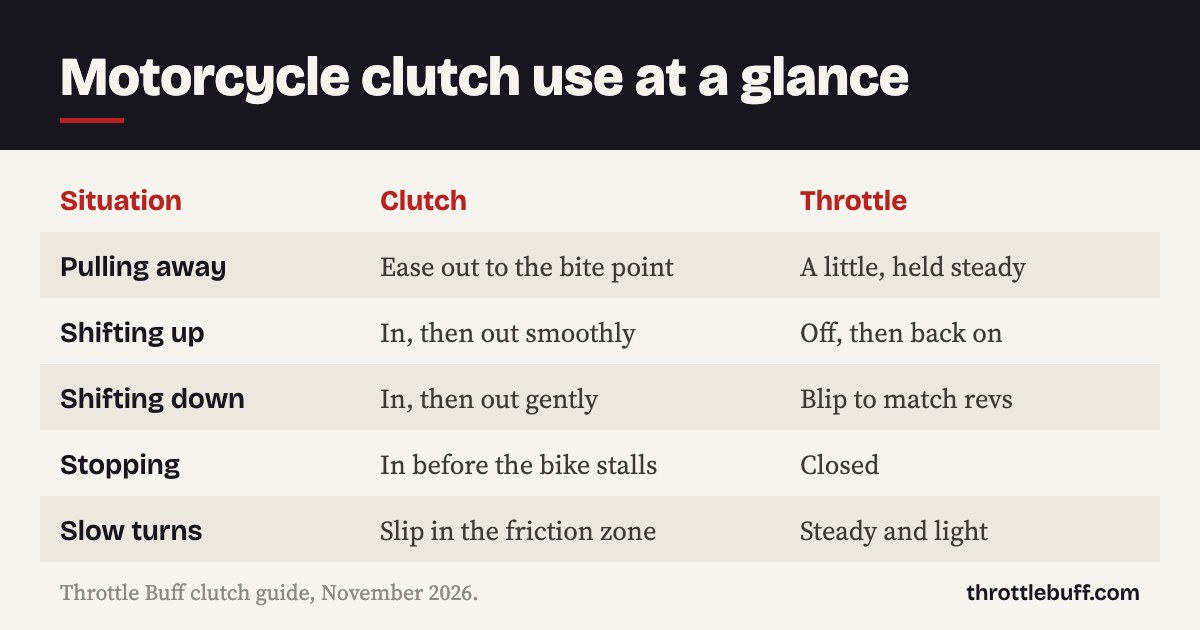
Motorcycle clutch use at a glance
| Situation | Clutch | Throttle |
|---|---|---|
| Pulling away | Ease out to the bite point | A little, held steady |
| Shifting up | In, then out smoothly | Off, then back on |
| Shifting down | In, then out gently | Blip to match revs |
| Stopping | In before the bike stalls | Closed |
| Slow turns | Slip in the friction zone | Steady and light |
How a motorcycle clutch works
Most bikes use a wet multi-plate clutch: a stack of friction plates and steel plates squeezed together by springs. Pulling the lever separates them, so the engine can spin without driving the gearbox. Let the lever out and the plates clamp back together. Between fully in and fully out is the friction zone, where the plates slip and pass some of the power. Our engine explainer shows where it sits in the drivetrain.
How to use the clutch on a motorcycle, step by step
1. Find the friction zone
On flat ground with the engine running, pull the lever in and select first. Without touching the throttle, let the lever out very slowly until the revs dip slightly and the bike starts to creep. That’s the bite point. Pull the lever back in, then repeat until you can find it without thinking.
2. Pull away smoothly
Add a little throttle and hold it steady, then ease the lever out to the friction zone. Hold it there for a moment as the bike rolls, then release the rest of the way while gently rolling on more throttle. If the engine bogs, you let the clutch out too fast or gave it too little throttle.
3. Shift up
Once you’re moving, close the throttle, pull the clutch in, lift the shift lever firmly into the next gear, then let the clutch out smoothly and roll the throttle back on. With practice, these become one quick movement. A gear indicator helps while you learn.
4. Shift down
Pull the clutch in, press the shift lever down one gear, and let the clutch out gently. A small blip of throttle before you release the lever matches engine speed to road speed, so the rear wheel doesn’t lurch or chirp.
5. Stop without stalling
As you brake, downshift through the gears. Pull the clutch in fully before the revs drop too low, and keep it in until you stop. Select first so you’re ready to go again.
How to properly use the clutch at slow speed
At walking pace, riders slip the clutch in the friction zone with steady throttle and a light touch of rear brake. That gives fine control in tight turns, parking lots and traffic. It’s the core of the slow-speed exercises taught in the MSF Basic RiderCourse, and of skills like parking a motorcycle.
Hill starts
Hold the bike with the rear brake, add throttle, and ease the clutch out to the bite point. When you feel the bike pull against the brake, release the brake and let the clutch out the rest of the way.
Common clutch mistakes
- Dumping the clutch. Letting go of the lever suddenly can stall the bike or make it jump forward.
- Riding the clutch. Holding it half in at normal speeds adds wear and heat. Use the friction zone only at low speed.
- Too many revs. Revving hard while slipping the clutch wears the plates. Use only the throttle you need.
- Pulling the clutch in mid-corner. It removes the drive that keeps the bike stable. Choose your gear before the turn; see how to corner with confidence.
These are among the most common beginner mistakes, and all fade with practice.
Two fingers or four?
Many new riders use all four fingers for full control. Others use two once the clutch feels familiar, leaving the rest on the grip. Either works. If the lever is hard to reach, an adjustable lever span can help, and well-fitted riding gloves make the action easier to feel.
Check the free play
The lever should move a little before you feel the clutch start to work. Your owner’s manual lists the right amount of free play and how to set it, usually with an adjuster at the lever or along the cable. Too little free play can make the clutch slip, and too much can make it drag so the bike creeps or shifts badly. Hydraulic clutches adjust themselves, so only the lever span changes.

FAQ
Do you need to use the clutch on a motorcycle every time you shift?
Learn with it every time. Some experienced riders make clutchless upshifts, and bikes with a quickshifter are designed for it, but downshifts and pulling away still need the clutch on most bikes.
Should you pull the clutch in when braking?
Not at the start. Keep it out while you slow, and downshift as you go, then pull it in before the engine stalls.
Is it bad to hold the clutch in at a red light?
For short waits it’s normal, and it keeps you ready to move. For long waits, neutral gives your hand a rest.
Why does my bike stall when I let the clutch out?
You’re releasing the lever too fast or with too little throttle. Practice finding the bite point slowly.
Is the clutch different on a Harley?
The method is the same. Some big cruisers have a heavier lever pull, so a little more grip strength helps.
Verdict
Learn the friction zone first, then pull away, shift and stop with smooth, deliberate lever movements. Practice in an empty lot, ideally in a course: here’s what to bring to an MSF course. NHTSA also recommends formal training for new riders.
Browse all our how-to and safety guides.