Throttle Buff is reader-supported: we may earn a commission when you buy through links on this page. Read our affiliate disclosure.
To break in a motorcycle helmet, wear it in short, frequent sessions, first at home and then on short rides, until the cheek pads and comfort liner settle to your face and head. That usually takes somewhere around 15 to 20 hours of wear. Break-in only loosens the soft padding, though. If you have a sharp hot spot on your forehead or the sides of your head, no amount of wearing will fix it, because the helmet is the wrong shape for you.
How long does it take to break in a motorcycle helmet?
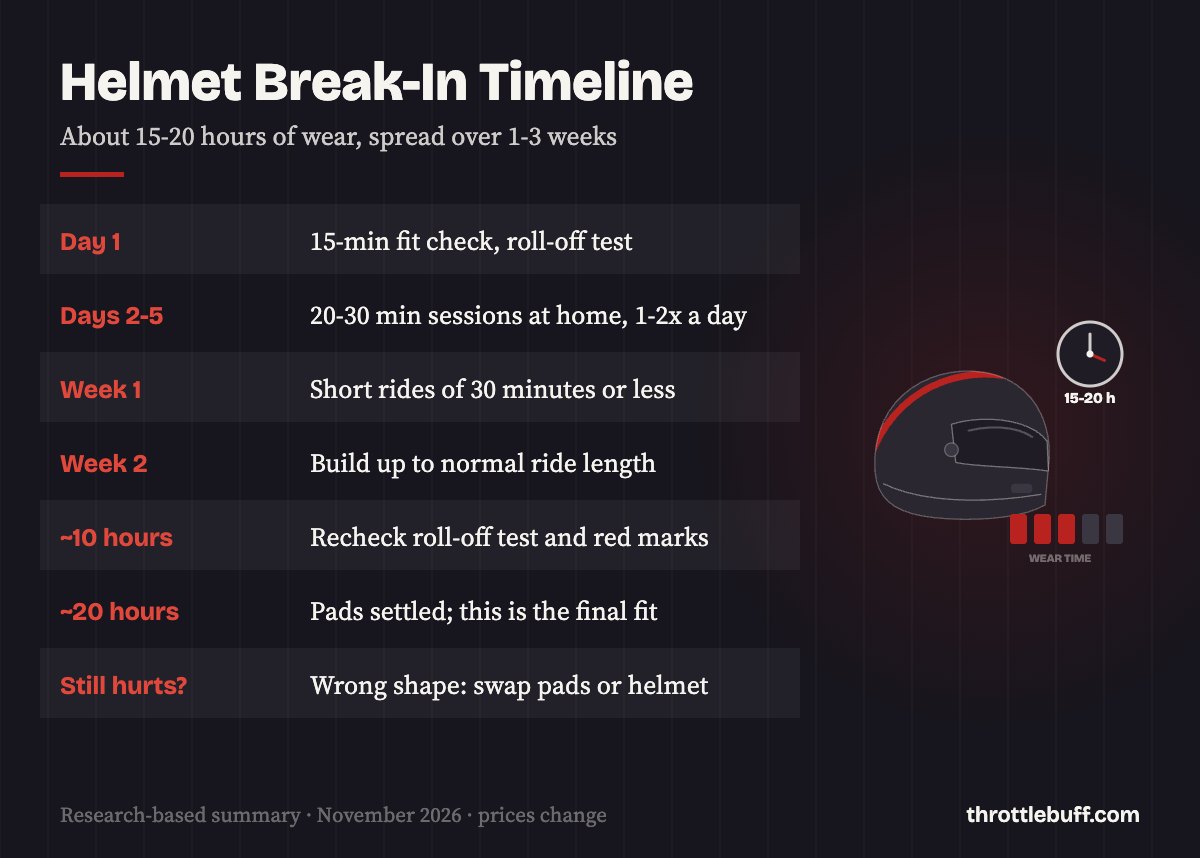
Plan on roughly 15 to 20 hours of wear spread over one to three weeks. That is the range most fitting guides give. AGV Sport’s helmet guide, for example, puts it at 15 to 20 hours and says the padding can give up about 20 percent of its original snugness along the way.
The big helmet makers are more careful with numbers. Arai, Shoei and Bell do not publish a fixed break-in figure in hours. Here is what they do say:
- Bell says in its dealer fitting instructions that helmets “are a little like shoes, in that they do break-in a little,” and that a new helmet should be “as tight as the customer can stand to wear it.”
- Arai says the interior should fit snugly all around the crown, and that you should feel some pressure at every contact point around the inside. It also warns that too much pressure can become uncomfortable later.
- Shoei handles fit with parts, not hours. It sells cheek pads in several thicknesses (the RF-SR set comes in 31, 35, 39 and 43mm). In Europe, dealers also offer the P.F.S. fitting service, which adjusts the crown pads to your measured head.
The practical takeaway: expect a noticeable change in the first 5 to 10 hours and most of the settling by about 20. A helmet that still hurts after that won’t get better.
What actually compresses during break-in (and what doesn’t)
A helmet has two layers inside the shell, and only one of them breaks in.
- Comfort liner and cheek pads. These are soft foam wrapped in fabric. They compress slightly with heat and pressure from your head and take a small permanent set. This is the break-in. The cheek pads usually change the most because they are the thickest soft foam in the helmet.
- EPS liner. The expanded polystyrene shell under the comfort liner is the part that absorbs a crash. It does not soften or mold to your head with wear. EPS crushes once, in an impact, and stays crushed. That is why the fit has to be right in the EPS shape from day one.
This explains the most common fit mistake. Soft padding can relieve general tightness, especially at the cheeks. It cannot fix a spot where the EPS itself presses on your skull through a thin layer of liner.
How to break in a motorcycle helmet: step by step
- Confirm the size first. Measure your head around the widest point, just above the eyebrows and ears, and match it to the brand’s chart. Our motorcycle helmet size calculator does the conversion for you.
- Do a 15-minute fit check at home. Strap it on and sit still. Snug, even pressure all around is good. Cheeks pushed up enough to make you look a bit like a chipmunk is normal for a new full-face. A focused ache in one spot is not.
- Check for red marks. Take the helmet off and look in a mirror. Even pink around the cheeks is fine. A distinct red spot on the forehead or above the ears is a pressure point, and Bell warns these can cause headaches that you may not notice for minutes or hours.
- Do the roll-off test. With the strap fastened and your head still, grab the back bottom edge and try to roll the helmet forward off your head. If it comes off, it is too big and break-in will only make it worse.
- Wear it around the house. Do 20 to 30 minute sessions, once or twice a day, for the first few days. Watch TV, answer email, do chores. Keep the tags on and the packaging if you might return it, and check the store’s return rules on worn helmets first.
- Move to short rides. Once an hour at home is comfortable, ride with it on trips of 30 minutes or less. Road vibration, body heat and moving your head help the pads settle faster than sitting still.
- Stretch the time out. Over the next week or two, build up to your normal ride length. Note where any discomfort shows up and whether it is fading.
- Re-check at about 10 and 20 hours. Redo the roll-off test and the mirror check. The helmet should still resist rolling off and shouldn’t shift when you shake your head. If a pressure point hasn’t faded by 20 hours, it is a fit problem, not a break-in problem.
What not to do when breaking in a helmet
Some “fast break-in” tricks online put the helmet at risk. Skip these:
- No heat. Don’t use a hair dryer, heat gun, oven, or a hot car to soften the liner. HJC’s owner information tells riders to keep helmets away from heat above 122°F and off hot surfaces. Heat can damage the EPS and the shell, and you can’t see the damage.
- No stretching tools. Overinflated balls, stuffed sweatshirts and stacked weights can over-compress the pads unevenly, so the helmet ends up loose in spots. They can’t reshape the EPS without damaging it.
- Don’t remove or carve the EPS. Sanding, cutting or digging out foam to make room for a hot spot removes the material that protects you. NHTSA says even simple modifications can reduce the protection a helmet gives, and helmets sold in the US must carry a “make no modifications” warning.
- Don’t remove pads to make room. Pulling out a cheek pad or crown pad without a thinner replacement leaves the helmet loose and changes how it sits in a crash. HJC lists removing parts as a modification.
- Don’t buy oversized. A helmet that feels comfortable on day one in the store is often too big once the pads settle. A loose helmet can shift at speed, let wind noise in and move during a crash.
Break-in or wrong size? How to tell
Normal break-in tightness is even, mostly at the cheeks, and fades a little with each session. Wrong fit tends to be sharp, focused and stubborn.
| What you feel | Likely cause | Fix |
|---|---|---|
| Tight cheeks, even pressure all around | Normal new helmet | Keep breaking it in |
| Hot spot on the forehead, roomy at the sides | Head is longer front to back than the helmet | Try a long oval shell |
| Pressure above the ears, gap at forehead | Head is rounder than the helmet | Try a round or intermediate oval shell |
| Crown pressure or headache on top | Shell too shallow or too small | Try a different model or size |
| Rolls off or shifts when you shake your head | Too big | Go down a size |
| Comfortable on top, cheeks too tight after 20 hours | Cheek pads too thick for your face | Swap to thinner cheek pads |
The forehead hot spot is the classic sign. It almost always means a long oval head in a helmet built for an intermediate or round head. Going up a size usually doesn’t help, because the bigger helmet gets loose at the sides while still pressing on the front. Check our picks for long oval heads and round heads, and see our guide to sizing and buying a helmet for how to measure your head shape.
Swapping cheek pads to fine-tune the fit
If the shell fits your head but the cheeks are still too tight (or too loose) after break-in, swap the cheek pads instead of changing helmets. Most premium brands sell pads in several thicknesses that fit every shell size of a given model. Thinner pads loosen the fit. Thicker pads tighten it.
Order pads made for your exact helmet model, and go one step thinner or thicker at a time. Prices below are approximate RevZilla list prices checked in November 2026 and may change.
Arai Corsair-X / Signet-X / Quantum-X Cheek Pads

Factory replacement pads for three current Arai full-faces, and they fit all shell sizes of those models. RevZilla lists several thicknesses, including 15, 25 and 35mm, so you can step down if the cheeks stay tight after break-in. About $62.
Shoei GT-Air 3 Cheek Pads

Factory replacement cheek pads for the Shoei GT-Air 3 sport-touring helmet. Like other Shoei pads, they come in different thicknesses for a looser or tighter fit. Check the size chart on the listing before ordering. About $87.
Other brands, including Bell, HJC and Scorpion, also sell model-specific pads. Search for your helmet name plus “cheek pads.” Don’t use pads from a different model, even from the same brand.
FAQ
How tight should a new motorcycle helmet feel?
Snug everywhere with no sharp pressure points. Your cheeks should be pushed in a little, and the helmet shouldn’t shift when you shake your head or roll off in the roll-off test. Bell says the cheek pads should be tight against your cheeks but not so tight that you bite them.
How much does a helmet loosen during break-in?
Some, but not a lot. Fitting guides commonly estimate the padding loses up to about 20 percent of its original snugness. The shell and EPS don’t change, so the overall shape stays the same.
Can I speed up breaking in a helmet?
The only safe way is more wear time: frequent sessions at home plus short rides. Heat, weights and stretching devices risk damaging the helmet or compressing the pads unevenly.
Will a forehead hot spot go away with break-in?
Usually not. Forehead pressure normally comes from the EPS shape, not the padding. It means the helmet is shaped for a rounder head than yours. A long oval helmet is the usual fix.
Do modular and open-face helmets need breaking in?
Yes. Any helmet with foam cheek pads and a comfort liner goes through the same settling. Open-face helmets often have smaller cheek pads, so they may change less.
Should I size up so I don’t have to break it in?
No. A helmet that feels perfect in the store will likely be loose after 20 hours. Buy the size that is snug but free of hot spots, and let the pads settle.
Does break-in shorten a helmet’s life?
No. The pads compress a little and then stay stable. Over the years the liner keeps wearing, which is one reason helmet makers recommend replacing helmets on a regular schedule. See our guide to motorcycle helmet expiration for details.
Breaking in a helmet takes patience, not tricks. Start with the right size and shape, wear it in short sessions, then short rides, and give it about 20 hours. If it still hurts after that, change the cheek pads or the helmet, not the foam.