Throttle Buff is reader-supported: we may earn a commission when you buy through links on this page. Read our affiliate disclosure.
How we chose: this guide is research-based, built from manufacturer specifications, safety certifications and owner feedback rather than hands-on testing. How we research.
The best motorcycle speedometer for most riders replacing a stock gauge in 2026 is a plug-and-play digital unit made for their bike, like the Dakota Digital MLX 2000 or Koso D2 for Harleys. For custom builds and dirt bikes converted for the street, the Koso DB-01RN packs a full dash into a tiny case, and the Motogadget Motoscope Tiny is the pick for minimalist café and bobber builds.
Quick picks
-
Best overall for Harley
- Type
- Digital
- Fitment
- Harley 4-1/2″ dash, plug-and-play
- Price
- $$$
-
Best value Harley upgrade
- Type
- Digital LCD
- Fitment
- Harley 2011–2024, stock harness
- Price
- $$
-
-
Best TFT with Bluetooth
- Type
- TFT, Bluetooth
- Fitment
- Universal
- Price
- $$$
- Best classic round gauge: Dakota Digital Round Performance
- Best minimalist: Motogadget Motoscope Tiny
- Best budget mechanical: Milwaukee Twins Mini
This 2026 rewrite replaces our old generic picks with seven current gauges from Dakota Digital, Koso, Motogadget and Milwaukee Twins, all stocked at RevZilla. Specs come from the manufacturers. We haven’t installed them ourselves.
Motorcycle speedometers compared
| Gauge | Type | Fitment | Tach | Gear indicator | Price |
|---|---|---|---|---|---|
| Dakota Digital MLX 2000 | Digital | Harley 4-1/2″ dash, plug-and-play | Bar-type | Yes | $$$ |
| Koso D2 LCD | Digital LCD | Harley 2011–2024, stock harness | Yes | Yes | $$ |
| Koso DB-01RN | Digital | Universal | Up to 15,000 rpm | No | $ |
| Koso RX-4 | TFT, Bluetooth | Universal | Up to 18,000 rpm | Yes (1–6) | $$$ |
| Dakota Digital Round Performance | Digital, 3-3/8″ | Custom | Separate gauge | No | $$ |
| Motogadget Motoscope Tiny | Analog needle, digital readouts | Universal, 49 mm | No | No | $ |
| Milwaukee Twins Mini | Mechanical | Universal, cable drive | No | No | $ |
The best motorcycle speedometers of 2026
1. Dakota Digital MLX 2000: best overall for Harley

The MLX 2000 replaces the stock gauge in Harleys with a 4-1/2″ dash and plugs straight in. It combines an adjustable speedometer with a bar-type tachometer, voltmeter, cylinder temperature (where available), clock, gear position, odometer with two trip meters, service and hour meters, and security and low-fuel indicators. It also records top speed and RPM, 0–60 times and quarter-mile times. The display adjusts for day and night, and you can choose from 31 illumination colors.
Pros
- True plug-and-play
- Huge range of readouts
- 31 colors, auto day/night
Cons
- Most expensive Harley option here
- Fits 4-1/2″ dash models only
2. Koso D2 LCD: best value Harley upgrade

The Koso D2 is a 100% plug-and-play tach and speedo combo that fits directly into the stock harness on 2011–2024 Harleys (check the fitment list for your model). It adds a programmable shift light, a gear indicator, engine temperature, battery voltage and tire pressure readouts, plus indicator lights. The LCD can switch between eight colors. It’s a cheaper route to a modern dash than the Dakota.
Pros
- Plug-and-play into stock harness
- Shift light and gear indicator
- 8 display colors
Cons
- Check model fitment carefully
- Fewer timing functions than the MLX
3. Koso DB-01RN: best universal digital
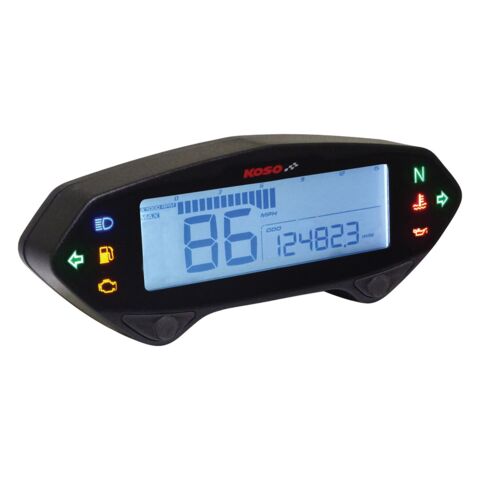
Building a custom or converting a dirt bike for the street? The DB-01RN packs a whole dash into a tiny case: speedometer, odometer, two trip meters, oil-change reminder, speed warning, top and average speed, a tachometer to 15,000 rpm with max RPM, hour meters, fuel gauge, voltmeter and clock. It also has indicator lights for neutral, high beam, turn signals, check engine, oil level, water temperature and low fuel, plus a shift light.
Pros
- Full dash in a tiny case
- Shift light and many indicators
- Lowest-priced digital pick
Cons
- Requires wiring work
- Small screen
4. Koso RX-4: best TFT with Bluetooth
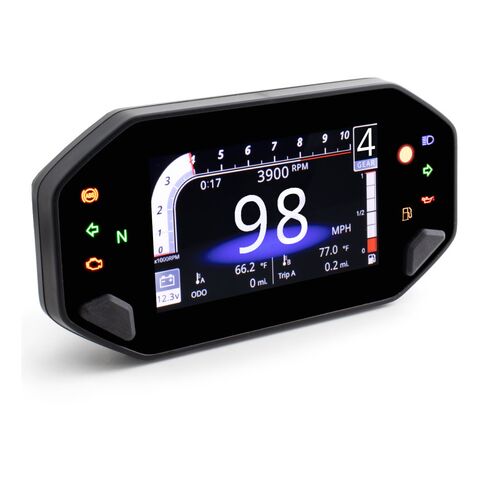
The RX-4 is a universal color TFT meter for riders who want a modern screen on a custom or older bike. Besides the speedometer, odometer, trip meters, gear indicator (1–6), tachometer to 18,000 rpm, shift light, fuel meter, air/fuel ratio and voltage readouts, it connects to an iPhone over Bluetooth to show incoming calls and music info. Brightness adjusts automatically, and there are five backlight colors.
Pros
- Color TFT screen
- Phone call and music info
- A/F ratio and gear indicator
Cons
- Expensive
- Bluetooth features listed for iOS
5. Dakota Digital Round Performance: best classic round gauge

From Dakota Digital’s 3000 Series, this is a 3-3/8″ gauge in a machined aluminum housing with a chrome bezel, so it suits classic customs. It reads 0–255 mph with odometer, trip and service meters, high-speed recall and 0–60 timing, and includes turn-signal and high-beam indicators. Dakota offers a matching tachometer (0–18,000 rpm, adjustable for 1–15 cylinders). It’s built for custom applications and comes with a 2-year warranty.
Pros
- Classic look, modern internals
- 0–60 timer and high-speed recall
- 2-year warranty
Cons
- Custom fitment, not plug-and-play
- Tach is a separate gauge
6. Motogadget Motoscope Tiny: best minimalist

Made in Germany, the Motoscope Tiny is a 49 mm analog speedometer driven by a precision stepper motor, with digital functions hidden underneath. Backlit indicator lights show neutral, turn signals, high beam and oil pressure, and a remote mini switch cycles through clock, odometer, trip, top speed and voltage. It’s only 24 mm deep and mounts with two M3 screws, which makes it perfect for café racers and bobbers where every millimeter counts.
Pros
- Tiny 49 mm footprint
- Analog look with digital functions
- Made in Germany
Cons
- No tachometer
- Wiring and sensor setup needed
7. Milwaukee Twins Mini: best budget mechanical

For a simple, cheap mechanical speedometer on a custom, the Milwaukee Twins Mini kit is hard to beat on price. It uses a 2:1 ratio and includes a 47″ cable. It’s a universal part, so it may need modification to fit, and you’ll need to match the drive ratio to your bike.
Pros
- Very low price
- Simple mechanical drive
- Cable included
Cons
- Universal fit may need modification
- Speed only
Best digital dashboards for dual-sport motorcycles
Dual-sport and adventure bikes need a dash that survives rain, mud and vibration and is readable in bright sun. Three good routes:
- Compact all-in-one: Koso DB-01RN. Its tiny case fits a dual-sport’s narrow cockpit and still gives you speed, two trip meters, hour meters (useful for off-road service intervals), tach, fuel gauge, voltmeter and warning lights.
- Color TFT: Koso RX-4. A bigger universal screen with a gear indicator, shift light and Bluetooth call and music info, better suited to adventure builds with room on the bars.
- GPS dash: Trail Tech Voyager Pro. A 4-inch, IP67-rated color screen that combines a speedometer with GPS navigation and buddy tracking for trail riding. See our Trail Tech Voyager Pro review.
Off-road, prioritize waterproofing, a vibration-damped mount and a screen you can read through goggles. If you mainly want navigation and phone apps on the road, a motorcycle CarPlay screen may suit you better than a replacement gauge.
How to choose a motorcycle speedometer
Plug-and-play or universal?
If your bike has a stock gauge you want to upgrade, a bike-specific unit like the Dakota MLX 2000 or Koso D2 plugs into the factory harness and keeps your existing sensors. Universal gauges like the Koso DB-01RN and RX-4 suit custom builds, but you’ll need to wire power, ground, indicators and a speed signal yourself. Our guide to working on your own motorcycle covers the basics.
Speed signal: wheel sensor, ECU or GPS
Electronic gauges usually read speed from a wheel or transmission sensor (a magnet passing a pickup) or from the bike’s own speed signal. Mechanical gauges use a cable from the front wheel or transmission. GPS speedometers need no sensor but can lag in tunnels and under trees. Whatever the signal, you’ll need to calibrate it.
Calibration and accuracy
Most digital gauges let you program tire circumference or pulses per mile. Measure your tire’s rolled-out circumference with you on the bike, or compare against a GPS app at a steady speed and adjust. Recheck after changing tire size or sprockets. A wrong setting also throws off your odometer, which matters for service intervals and resale. See what counts as high mileage.
Features worth having
A gear indicator, fuel level, voltmeter and shift light are the most useful extras. Some gauges also show tire pressure if you add sensors; see our guide to the best motorcycle TPMS. If you want navigation and phone features, a separate CarPlay screen or motorcycle GPS may suit you better.
Weather and visibility
Look for a display that’s readable in direct sun and adjusts for night. Seal all connectors against water, and route wires away from the steering head so they don’t pinch at full lock.
Is it legal to change your speedometer?
Most U.S. states require a working speedometer, and federal law makes it illegal to roll back or misrepresent odometer mileage. When you swap gauges, note the old mileage and keep a record. The NHTSA odometer fraud page explains the rules.
FAQ
Are digital speedometers more accurate than analog?
Not automatically. Accuracy depends on calibration and the speed signal. A correctly calibrated digital gauge is easy to read precisely, while analog needles are easier to read at a glance.
Can I install an aftermarket speedometer myself?
Plug-and-play units are an easy DIY job. Universal gauges need wiring skills and sometimes a new speed sensor.
What happens to my mileage when I replace the speedometer?
Many digital gauges let you set the starting odometer reading. Record the old mileage and keep receipts in case you sell the bike.
What is the best digital dashboard for a dual-sport motorcycle?
For a compact, all-in-one gauge, the Koso DB-01RN. If you want trail navigation built in, a GPS dash like the Trail Tech Voyager Pro is the better fit.
Do I need a speed sensor?
Plug-and-play gauges use your bike’s existing signal. Universal gauges on custom bikes may need a separate magnet-and-pickup sensor.
Related reading: best dual-sport helmets and best dual-sport tires.
Verdict
Harley riders should start with the Dakota Digital MLX 2000 or the cheaper Koso D2. Custom builders should look at the Koso DB-01RN for function or the Motogadget Motoscope Tiny for looks. Fitment and wiring guides are on Dakota Digital and Motogadget. If you’re tuning your Harley at the same time, see our guide to Harley fuel management systems.
Browse all our accessory guides.