Throttle Buff is reader-supported: we may earn a commission when you buy through links on this page. Read our affiliate disclosure.
The best motorcycle helmet for a wide face is the one that lets you change cheek pad thickness, because the cheek pads, not the shell, are what press on wide cheekbones and a broad jaw. Our top pick is the Shoei RF-1400: Shoei sells its cheek pads in four thicknesses from 31mm to 43mm, so you can buy the shell size that fits your head and then thin out the pads for your face. On a budget, the HJC i10 does the same job for about a quarter of the price.
Quick picks
-
Best overall
- Type
- Full-face
- Cheek pads
- 31, 35, 39, 43mm
- Price
- $$$
-
-
-
Best adjustable fit
- Type
- Full-face
- Cheek pads
- AirFit plus -5mm pads
- Price
- $$$
- Best modular: HJC i100
- Best adventure: Klim Krios Pro
- Best value with MIPS: Bell Qualifier DLX MIPS
We did not wear these helmets. We picked them from published specs, safety certifications, manufacturer fit data and owner reviews. We gave the most weight to one thing: how many cheek pad thicknesses each brand sells for that model, and how easy they are to swap. We also looked at whether the brand publishes stock pad sizes, whether replacement pads were in stock at major retailers, and features that make a snug helmet easier to live with, such as emergency pad release, a wide opening or a flip-up chin bar. Every helmet below is a current full-face or modular model that RevZilla sells, and each one carries at least a DOT rating.
Wide-face motorcycle helmet comparison
| Helmet | Type | Certification | Cheek pad options | Price |
|---|---|---|---|---|
| Shoei RF-1400 | Full-face | DOT, Snell M2025 | 31, 35, 39, 43mm | $$$ |
| HJC i10 | Full-face | DOT, Snell M2020 | 23 to 40mm by size | $ |
| Arai Regent-X | Full-face | DOT, Snell | 12 to 35mm | $$$$ |
| Scorpion EXO-R1 Air | Full-face | DOT, ECE 22.06 | AirFit plus -5mm pads | $$$ |
| HJC i100 | Modular | DOT | 15 to 35mm | $$ |
| Klim Krios Pro | Adventure | DOT, ECE 22.06 | 10 to 30mm | $$$$ |
| Bell Qualifier DLX MIPS | Full-face | DOT, MIPS | 30, 35, 40mm | $$ |
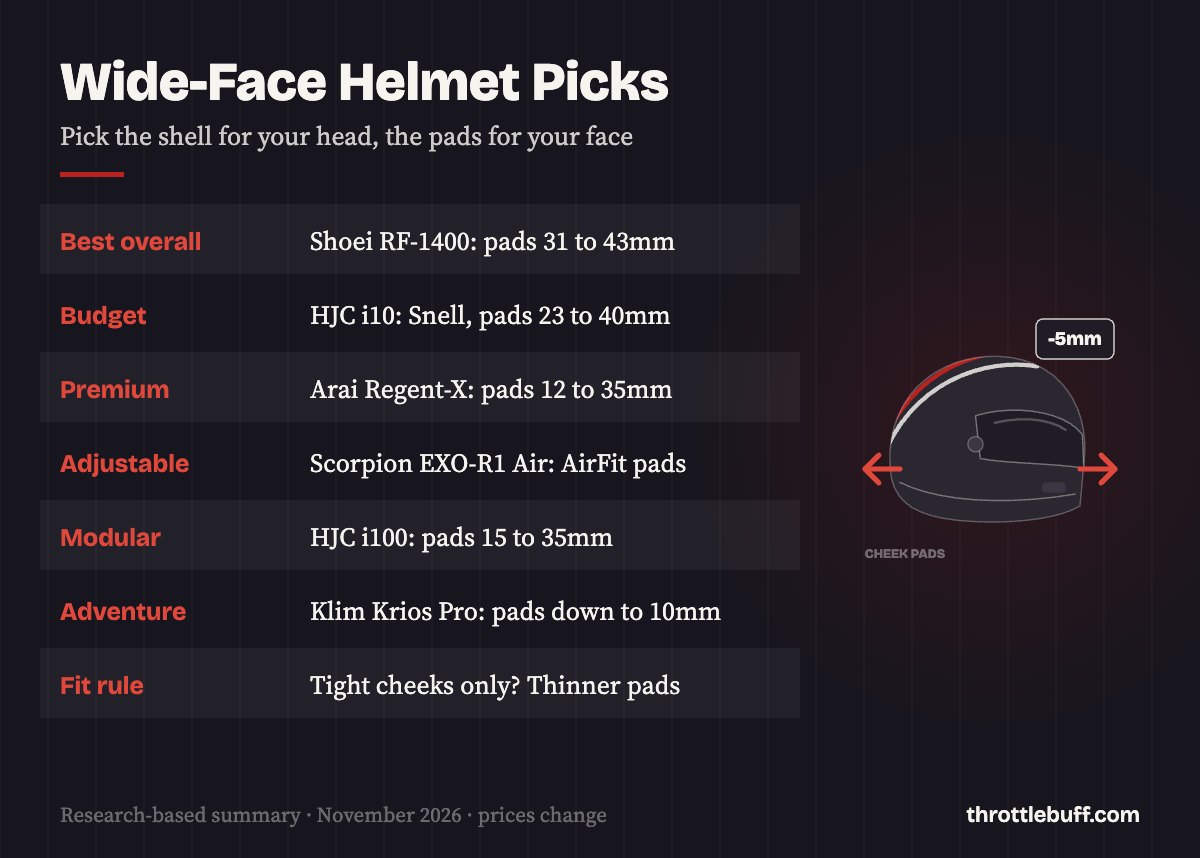
Specs come from manufacturer and retailer listings checked in November 2026. Price tiers: $ under $200, $$ $200 to $399, $$$ $400 to $649, $$$$ $650 and up, based on RevZilla list prices for solid colors. Prices change often.
The best motorcycle helmets for wide faces
1. Shoei RF-1400: best overall for wide faces

The RF-1400 is our top pick because Shoei makes fit adjustment easy and well documented. Shoei sells RF-1400 cheek pad sets in 31mm, 35mm, 39mm and 43mm. According to Shoei’s own sizing chart, the small through XL helmets ship with 35mm pads. If the helmet fits your crown and forehead but squeezes your cheekbones, you can order the 31mm set and get 4mm more room on each side without changing the shell. That is about 8mm of total width across your face.
The shell is an intermediate oval, which suits most riders in North America. It carries DOT and Snell M2025 ratings on the RevZilla listing, so it meets the stricter US track and safety standard. The cheek pads also use Shoei’s Emergency Quick Release System, which lets first responders pull the pads out before removing the helmet. That matters more than usual for riders with a wide jaw, because a tight helmet is harder to slide off an injured rider.
The main drawback is price. At about $550 for a solid color, the RF-1400 costs more than most of this list, and a spare pad set adds about $65.
Pros
- Four cheek pad thicknesses, documented by Shoei
- Snell M2025 and DOT
- Emergency quick-release cheek pads
- Widely stocked, so swapping pad sizes is easy
Cons
- About $550 before you buy extra pads
- Intermediate oval shell will not help if your whole head is round
2. HJC i10: best budget helmet for a wide face

The i10 is one of the cheapest Snell-rated helmets you can buy, and HJC publishes cheek pad thickness for every size, which is rare at this price. On HJC’s chart, the medium uses 30mm pads, the large uses 35mm, the XL goes back to 30mm, and the 2XL and 3XL drop to 25mm. The extended sizes, 4XL and 5XL, use 23mm pads.
That pattern is useful for wide-face riders. If you wear a large and feel pinched at the cheekbones, a 30mm set gives you 5mm more space on each side. HJC sells i10 pads separately, though stock comes and goes, so check availability before you rely on a swap. The polycarbonate shell comes in two shell sizes, and the helmet runs from XS to 5XL.
The trade-offs are typical for a budget lid. It is heavier and louder than the premium picks, and it has no internal sun visor. But if your main problem is cheek pressure and you want to spend less than $200, this is the pick.
Pros
- DOT and Snell M2020 for well under $200
- HJC lists pad thickness for every size
- Sizes up to 5XL
- Bluetooth-ready speaker pockets
Cons
- Replacement pads are often out of stock
- Heavier and noisier than premium helmets
- No drop-down sun visor

Arai offers the widest range of cheek pad thicknesses in this guide. Regent-X pads are sold in 12mm, 15mm, 20mm, 25mm, 30mm and 35mm. That 23mm spread means a dealer can fit almost any face width inside the shell size that suits your head.
Two other details help a wide jaw. First, Arai gave the Regent-X shell an opening that is 5mm wider at the cheeks and chin than the model it replaced, which makes it easier to pull on and off. Second, the pads use Arai’s Facial Contour System, which lets the pads move out of the way as the helmet goes on and then settle around the jaw. Arai also builds a peel-away foam layer into the crown liner, reached through pockets in the head liner, for fine tuning at the temples.
One thing to know: unlike some of Arai’s pricier models, the Regent-X cheek pads do not have a 5mm peel-away layer. If you need thinner pads, you buy a thinner set, at about $37. The helmet is DOT and Snell rated and costs about $660 in solid colors.
Pros
- Six cheek pad thicknesses, 12mm to 35mm
- Wider cheek and chin opening
- Facial Contour System moves the pads for easier on and off
- Five shell sizes for a closer overall fit
Cons
- About $660 for a solid color
- No peel-away layer in the cheek pads
- No internal sun visor
4. Scorpion EXO-R1 Air: best adjustable fit

Scorpion’s AirFit system takes a different approach. The cheek pads have air bladders inside them, and a small pump bulb lets you inflate them once the helmet is on. A release button lets the air back out. For a wide face, that means you can choose a cheek pad that feels roomy when you put the helmet on, then add air until it feels snug. Scorpion’s manual says to deflate the liner before you take the helmet off, which also makes removal easier over wide cheekbones.
Scorpion also sells EXO-R1 Air cheek pads in a “-5mm” version that is 5mm thinner than the standard pad, currently listed for medium and large. Pads cost about $28 and include the AirFit pump. The helmet has DOT and ECE 22.06 ratings, a composite shell in three shell sizes, and emergency release tabs for the cheek pads.
This is a track-focused helmet, so it has a race-style head position and a firmer interior than a touring lid. If you ride upright most of the time, the HJC i100 or the Shoei may be more comfortable.
Pros
- AirFit lets you adjust cheek pressure on the fly
- Thinner -5mm pads available
- DOT and ECE 22.06
- Emergency cheek pad release
Cons
- Sport-focused fit and head position
- -5mm pads only listed in two sizes
- You must remember to deflate before removing
5. HJC i100: best modular helmet for a wide face

Modular helmets have a natural advantage for wide faces: you flip the chin bar up and the helmet goes on without dragging the pads over your cheeks. The i100’s chin bar swings all the way back to the rear of the helmet, and HJC homologated it to be worn open or closed in markets that use ECE 22.06. RevZilla lists the US version as DOT approved.
HJC sells i100 cheek pads in a wide range: 35mm, 30mm, 25mm, 20mm and 15mm, split across shell sizes. That gives a wide-face rider room to drop at least one step without changing helmet size. The helmet also has a drop-down sun visor, a Pinlock-ready shield and pockets for HJC’s Smart communicators. It costs about $360.
The trade-off is weight. Modular helmets carry extra hardware in the chin bar hinge, so they are heavier than a comparable full-face. If you want a lighter modular, expect to pay more.
Pros
- Flip-up chin bar avoids dragging pads over your cheeks
- Cheek pads from 15mm to 35mm
- Drop-down sun visor and Pinlock-ready shield
- Reasonable price for a modular
Cons
- Heavier than a full-face
- Pad sizes are split by shell, so check yours before ordering
6. Klim Krios Pro: best adventure helmet for a wide face

Klim sells Krios Pro cheek pads in 10mm, 15mm, 20mm, 25mm and 30mm for the large through 3XL shell, and 15mm to 30mm for XS through medium. That 10mm option is one of the thinnest pads on any helmet we looked at, which makes the Krios Pro a strong choice for riders with very wide cheekbones who ride adventure bikes.
The shell is hand-laid carbon fiber, the helmet weighs about 3.4 pounds, and it uses Koroyd, a honeycomb-style energy-absorbing material, along with EPS. It is DOT and ECE 22.06 certified. The peak, wide eye port and goggle-friendly design make it work on and off the road.
At about $725, it is the most expensive helmet here. Klim pads cost about $35 a set, but some sizes sell out, so order early if you know you need thinner pads.
Pros
- Cheek pads as thin as 10mm in larger sizes
- Light carbon shell, about 3.4 lb
- DOT and ECE 22.06
- Works with goggles for off-road riding
Cons
- About $725
- Peak adds wind drag at highway speed, like most adventure helmets
- Some pad sizes sell out
7. Bell Qualifier DLX MIPS: best value with MIPS

The Qualifier DLX MIPS adds a MIPS low-friction layer for rotational impact protection and a ProTint photochromic shield that darkens in sunlight, all for about $250. Bell has used three cheek pad thicknesses for this helmet: 30mm, 35mm and 40mm.
Here is the catch for wide faces. According to the OEM sizing chart, the medium Qualifier DLX ships with 40mm pads, thicker than the small or large. If you are a medium with wide cheekbones, the stock pads may feel very tight. A 35mm or 30mm set can fix that, but Bell has discontinued some pad sizes, so confirm that the thickness you need is in stock before you buy the helmet. The polycarbonate shell comes in three shell sizes, and the helmet has speaker pockets for a communicator.
We ranked it last because pad availability is less certain than with Shoei, HJC, Arai or Klim. If you can get the right pads, it is a good value.
Pros
- MIPS and a photochromic shield for about $250
- Three cheek pad thicknesses
- Speaker pockets
Cons
- Medium ships with thick 40mm pads
- Some replacement pad sizes discontinued
- No Snell rating
Wide face vs. round head: why they need different fixes
Many riders with a wide face assume they need a round-oval helmet. Sometimes that is true, but often it is not. Head shape and face width are two separate measurements, and a helmet fits them with two separate parts.
Head shape is the outline of your head seen from above, at about forehead height. Helmet makers group it into long oval, intermediate oval and round oval. The shell and the EPS liner set this shape. You cannot change it with pads. If you feel hard pressure on the sides of your forehead or at your temples, the shell is too narrow for your head, and you need a rounder model. That is what our best motorcycle helmet for round heads guide covers.
Face width is the distance across your cheekbones and jaw. The cheek pads, not the shell, touch this part of your head. If the crown fits well but your cheeks are crushed, your jaw aches after an hour, or the helmet is hard to pull over your cheekbones, the shell is fine. You need thinner cheek pads.
Here is a quick way to tell which problem you have:
- Pressure on the forehead sides or temples: head shape. Try a rounder shell.
- Pressure on the front of the forehead and back of the head: head shape. You may have a long oval head; see our long oval helmet guide.
- Pressure only on cheekbones or jaw: face width. Keep the shell, change the pads.
- Tight everywhere: the helmet is too small. Go up a size before you change pads.
Some riders have both a round head and a wide face. If that is you, start with a round-oval shell, then use thinner pads in that helmet. Riders who need a larger size overall should also check our best motorcycle helmet for big heads list, since many larger shells come with thinner stock pads.
How to fit a helmet when you have a wide face
Follow these steps in order. Changing pads before you get the size right is the most common fitting mistake.
Step 1: Measure your head
Wrap a soft tape measure around your head about one inch above your eyebrows and just above your ears. Pull it snug and take the largest of several readings. Use that number and the brand’s size chart to pick a size. Each brand’s chart is slightly different, so use the chart for the helmet you are buying.
Step 2: Check the crown and forehead first
Put the helmet on and ignore your cheeks for a moment. The helmet should press evenly around your head with no single hot spot on the forehead. Hold the chin bar and try to rotate the helmet left and right. Your skin should move with it. If the helmet spins on your head, it is too big. If you get a headache at the forehead within 10 to 15 minutes, the shell size or shape is wrong.
Step 3: Now judge the cheeks
A new helmet should feel snug on the cheeks. Light contact that pushes your cheeks in a little is normal, and the pads will compress as they break in over the first several rides. Signs that the pads are too thick for your face:
- You can’t open your mouth enough to talk
- You bite the inside of your cheek
- Your cheekbones or jaw ache after 20 to 30 minutes
- Pulling the helmet on or off hurts your ears or cheekbones
- The helmet pushes up because the cheeks have nowhere to go
Step 4: Swap to a thinner pad
Most brands label their pads by thickness in millimeters. Drop one step at a time, usually about 4 to 5mm. Pads come in pairs, so a single step gives you that much extra room on each side. Do not jump two steps at once unless the stock pads are clearly far too tight.
Two rules to follow:
- Only use pads made for your exact model and shell size. Pads from another helmet may not clip in correctly and may change how the helmet sits.
- Never ride with the cheek pads removed. The pads help hold the helmet in place in a crash. Thinner pads are fine; no pads are not.
Step 5: Re-check stability
After a pad swap, do the rotation test again. Then fasten the strap and try to roll the helmet forward off your head by pushing up on the back. If it rolls off or slides over your eyes, the fit is now too loose. Go back up one pad size.
Wide-face fit checklist
Use this list when you try a helmet on at a store or at home before you remove the tags:
- Size first. Measure your head and pick the size from the brand’s chart. Do not size up to make room for your cheeks.
- Even crown pressure. No hot spot on the forehead or temples after 15 minutes.
- Snug, not painful, cheeks. Your cheeks push in a little, but you can talk and your jaw does not ache.
- Easy on and off. Spread the chin strap ends outward as you pull the helmet on, which opens the cheek pads slightly. If it still hurts your ears or cheekbones every time, the pads are too thick.
- Rotation test. Hold the chin bar and turn it side to side. Your skin should move with the helmet.
- Roll-off test. With the strap fastened, push up on the back of the helmet. It should not roll forward over your eyes.
- Glasses and comms. Try the helmet with your glasses and any speakers installed, because both add pressure near the cheeks.
- Pad plan. Know which thinner pad set fits your shell size and whether it is in stock.
If a helmet passes every check except the cheeks, it is a good candidate for a pad swap. If it fails the crown check, move on to a different shell shape.
What to look for in a wide-face helmet
Published cheek pad thicknesses
This is the most important feature. Brands like Shoei, Arai, HJC and Klim list pad thicknesses by size, and dealers stock them. If a brand does not sell replacement pads in different thicknesses, you are stuck with what comes in the box.
Pad stock and price
A thinner set costs about $28 to $65 depending on brand. Check stock before you buy the helmet. In our research, several pad sizes for HJC, Klim and Bell were out of stock or discontinued at major retailers.
Adjustable pads
Systems like Scorpion’s AirFit let you start with a roomier pad and add air until it is snug. This is helpful if your face is wide but you still want a firm hold at speed.
A wider opening or a modular design
Riders with a wide jaw often struggle more with getting the helmet on than with wearing it. A modular helmet like the HJC i100 avoids the problem. Among full-face helmets, look for a wider neck opening, like the Arai Regent-X’s.
Emergency cheek pad release
Helmets that fit wide faces snugly can be hard to remove after a crash. Emergency release tabs, like Shoei’s E.Q.R.S. or the tabs on the Scorpion EXO-R1 Air, let trained responders pull the pads first.
Safety ratings
Every helmet sold for road use in the US must meet DOT FMVSS 218. Snell and ECE 22.06 add more testing. A helmet that fits well protects better than a higher-rated one that sits loose or crooked.
Glasses
Wide faces and glasses often clash, because the arms of your glasses must slide between thick pads and your temples. Thinner pads help. If you wear glasses every ride, try the helmet on with them before you commit.
Cheek pad thickness explained
Cheek pad thickness is usually listed in millimeters and measures how far the pad stands out from the EPS liner at its thickest point. A bigger number means a thicker pad and a tighter fit. A smaller number means more room for your face.
Brands often use different pad thicknesses inside the same shell to cover several helmet sizes. That is why the numbers sometimes jump around. On the HJC i10, for example, the medium uses 30mm pads and the large uses 35mm, because the large shares a shell with a smaller size and needs thicker pads to fill it. On the Bell Qualifier DLX, the medium ships with 40mm pads while the large uses 35mm. If you have a wide face and sit near the top of one size’s range, these details can make the difference between a helmet that fits and one that hurts.
Here is how the stock pads compare for a typical medium or large, based on manufacturer and retailer size charts:
| Helmet | Stock pads (M/L) | Thinnest option |
|---|---|---|
| Shoei RF-1400 | 35mm | 31mm |
| HJC i10 | 30mm (M), 35mm (L) | 23mm (5XL size) |
| Arai Regent-X | Varies by size | 12mm |
| Scorpion EXO-R1 Air | Standard | -5mm version |
| HJC i100 | Varies by shell | 15mm |
| Klim Krios Pro | Varies by shell | 10mm |
| Bell Qualifier DLX MIPS | 40mm (M), 35mm (L) | 30mm |
Pads only swap within a shell size
You can’t take any thinner pad from a bigger helmet and drop it into yours. Pads are shaped to the EPS liner of one shell. Scorpion, for example, states that EXO-R1 Air pads are interchangeable only within a shell size: XS to medium share one shell, large has its own, and XL to 3XL share a third. HJC’s i100 pads are also sold by shell group. Before you order, find your helmet’s shell group on the brand’s chart and buy pads listed for it.
Order pads at the same time as the helmet
If you already know the stock pads will be tight, consider ordering one thinner set with the helmet. Try the helmet with the stock pads first, indoors, for at least 30 minutes. If your cheeks ache, swap in the thinner set and try again. Check the retailer’s return rules first, and keep tags and packaging on both until you are sure.
Wide faces, speakers and comms
Bluetooth speakers sit in pockets in the EPS behind the ear pads, right next to the cheek pads. On a wide face, a thick speaker can add pressure on the ears or the back of the cheekbone. Look for helmets built around a comm unit. The Arai Regent-X cheek pads have recessed speaker pockets, the Bell Qualifier DLX MIPS has integrated speaker pockets, HJC designed the i10 and i100 to accept its Smart communicators, and Klim lists the Krios Pro as compatible with the Sena 10U. If you add a comm unit, try the helmet on with the speakers installed before you decide the pads are right.
Break-in: what changes and what doesn’t
Cheek pads and comfort liners are made of foam that compresses with use. A helmet that feels a bit tight on the cheeks in the store will usually feel looser after several rides. That is why most fitting advice says a new helmet should feel snug.
Break-in has limits, though. It will not fix a shell that is too narrow for your head, and it will not turn a painful fit into a comfortable one. If you get real pain, numbness or a headache within the first half hour, the pads or shell are wrong for you. Do not wait for break-in to solve it.
Also remember that pad foam keeps compressing over the life of the helmet. A fit that feels right with thin pads on day one may become loose after a few seasons. If that happens, you can move back up to a thicker set. Manufacturers generally recommend replacing a helmet after about five years or after any crash.
FAQ
What is the best motorcycle helmet for a wide face?
Based on our research, the Shoei RF-1400 is the best choice for most riders because Shoei sells four cheek pad thicknesses, from 31mm to 43mm, and documents which one comes in each size. The HJC i10 is the best budget option.
Do I need a round-oval helmet if I have a wide face?
Not always. A round-oval shell fixes pressure on the sides of your forehead. If your forehead and crown fit fine and only your cheeks are tight, keep the shell and switch to thinner cheek pads.
Can I just buy a bigger helmet?
Not if the rest of the helmet fits. A bigger size will feel loose on your crown, and it can move or come off in a crash. Fix cheek tightness with thinner pads, not a bigger shell.
How tight should cheek pads be?
Snug enough that your cheeks push in a little and the helmet does not spin on your head. You should be able to talk and you should not get jaw pain after 20 to 30 minutes. New pads compress over the first several rides.
Are thinner cheek pads safe?
Yes, if they are the manufacturer’s pads for your exact model and shell size, and the helmet still passes the rotation and roll-off checks. Do not cut down pads yourself and never ride with them removed.
Which helmet brand is best for a wide face?
No brand fits every wide face, and shell shape varies by model even within one brand. For face width, look at cheek pad options instead of the logo. Shoei, Arai, HJC and Klim all publish pad thicknesses for the models in this guide, and Scorpion adds inflatable AirFit pads.
Are modular helmets better for wide faces?
They are easier to put on and take off because you flip the chin bar up first. Once closed, they fit the cheeks like any full-face helmet, so you still need the right pad thickness.
Can I use cheek pads from a larger helmet size?
Only if both sizes share the same shell. Pads are shaped to the liner of one shell size, so pads from a different shell may not attach correctly. Check the brand’s shell chart first.
Why does my helmet hurt my cheeks but not my head?
Because the shell fits your head shape but the stock pads are too thick for your face width. This is the most common wide-face problem, and a thinner pad set usually fixes it.
How much do replacement cheek pads cost?
Based on current retailer listings, about $28 for Scorpion EXO-R1 Air pads, about $35 to $37 for HJC, Klim and Arai, and about $65 for Shoei RF-1400 pads.
If your cheekbones or jaw are the only tight spots, you probably do not need a new helmet shape, just thinner pads. Pick a shell that fits your crown, then choose a model with good cheek pad options. The Shoei RF-1400 is our top pick, the HJC i10 is the best low-cost route, and the Arai Regent-X and Klim Krios Pro give you the widest pad ranges if you are willing to pay more.